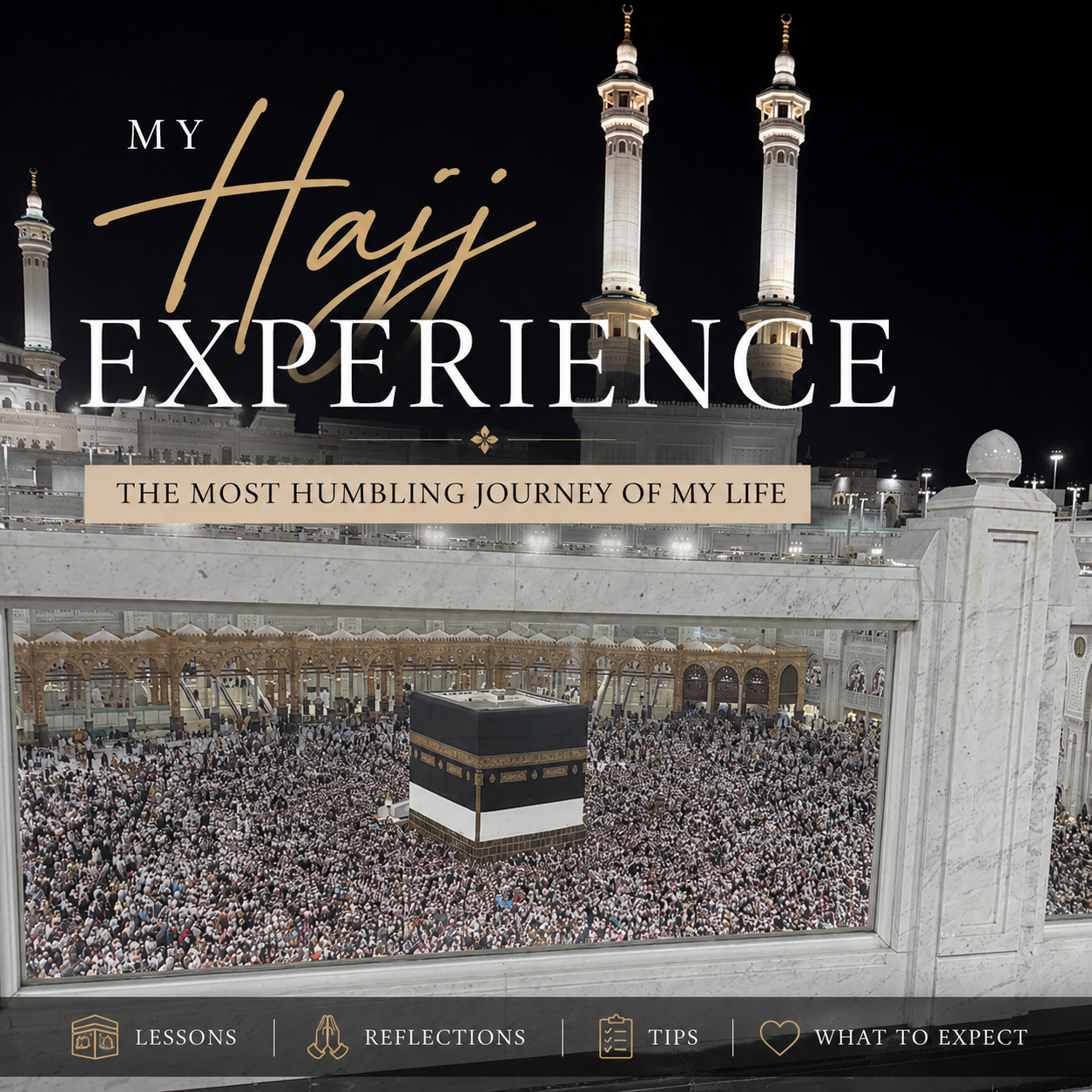
What Hajj Really Felt Like
It has been about two weeks since I performed Hajj, one of the most spiritually intense journeys any Muslim could ever experience in their lifetime, and before life settles back into normal and the details begin to blur, I wanted to document my Hajj experience while it is still fresh.
Although if I am being honest, I do not think Hajj is the kind of experience one ever truly forgets.
Alhamdulillah, Allah blessed me with the opportunity to perform Hajj this year.
One of the things I looked forward to most about living in Saudi Arabia was not just the opportunity to perform Umrah and visit the Prophet’s Mosque as often as I could, but eventually, Hajj too.
I just did not think it would happen this soon.
Leaving my baby behind for the first time since having him was honestly one of the hardest parts of this decision. I went back and forth so many times about postponing it. Should I wait till next year? Should I go when he is older? Would I be able to focus on the experience while worrying about him?
But Alhamdulillah, I eventually decided to go.
And now, looking back, I am so deeply grateful that I did.
Booking My Hajj Through Nusuk
Like other pilgrims within Saudi Arabia, I booked my Hajj package through the Nusuk app and selected a company/package that seemed most suitable for me.
If you are planning Hajj, one thing I would strongly recommend is paying attention to logistics when selecting your package.
Things like:
- Closeness of Mina camp to Jamarat
- Camp quality in Mina
- Transportation arrangements between Mina, Arafah, and Muzdalifah
- If package has access to the train.
Trust me, these things matter more than you think when you are walking long distances in 40+ degree weather.
Choosing My Type of Hajj: Why I Chose Hajj Qiran
Before Hajj begins, one of the initial decisions a pilgrim has to make is the type of Hajj they intend to perform.
The three main forms are:
Hajj Tamattu’ – performing Umrah first, exiting Ihram, then re entering Ihram for Hajj.
Hajj Qiran – combining Umrah and Hajj in one Ihram without exiting Ihram in between.
Hajj Ifrad – performing Hajj alone without Umrah.
Since I was travelling from Madinah shortly before the days of Hajj and wanted to follow the form of Hajj performed by the Prophet ﷺ, I opted for Hajj Qiran.
According to authentic narrations, the Prophet ﷺ performed Qiran and remained in Ihram until the sacrifice was done. (Sahih Muslim)
Travelling from Madinah to Makkah
My Hajj journey officially began on the 7th of Dhul Hijjah.
The meeting point for members of my Hajj package was the Madinah train station.
We received our Hajj tags and Nusuk cards before boarding the train to Makkah.
Arriving in Makkah: Tawaf and Sa’i
Immediately after arriving in Makkah, we headed straight to Masjid al Haram to perform Tawaf al Qudum (Arrival Tawaf) and Sa’i.
Seeing the Ka‘bah yet again felt surreal.
Every single time I stand before it, I feel deeply privileged. Out of billions of people in the world, Allah chose me to stand there.
Alhamdulillah.
This time, we were able to perform our Tawaf directly in the Mataf area close to the Ka‘bah itself, which felt extra special because during previous visits with my baby, I had often prayed or performed Tawaf on the upper floors.
After completing Tawaf, we proceeded to Sa’i between Safa and Marwah.
After completing Tawaf and Sa’i, we headed back to the coach bus to proceed to Mina.
Mina: Better Than I Expected
I had seen countless pictures and videos of Mina camps online over the years.
I even vaguely remembered seeing Mina during Ziyarah many years ago when I first visited Saudi Arabia with my mum.
Still, nothing prepares you for seeing endless rows of white tents stretching infinitely before you.

The camp was located uphill, so we had to leave our coach and transfer to another bus to get there.
Alhamdulillah though, the accommodation was surprisingly comfortable.


After such a long day, we had dinner and rested.
Our Hajj company had also prepared a really useful welcome bag containing essentials that genuinely made the experience easier.
Toiletries, useful supplies, and practical items for Arafah and Muzdalifah had already been packed in.
I am naturally an over-packer, so I already came with half my house in my bag, but I still found the supplies provided incredibly useful.
8th Dhul Hijjah (Yawm al Tarwiyah): Preparing for the Days of Hajj
Since we arrived in Mina a day earlier, the 8th of Dhul Hijjah, known as Yawm al Tarwiyah, was relatively calm.
This day is traditionally spent in Mina in preparation for the major rites ahead.
We spent the day resting, doing ibadah, reading Qur’an, making dua, mentally preparing for Arafah and packing essentials.
In hindsight, I am really glad we got this slower day because it was an opportunity to rest before the days that followed.
9th Dhul Hijjah: Arafah — The Heart of Hajj
The Prophet ﷺ said:
“Hajj is Arafah.”
(Tirmidhi)
If there is one day that defines Hajj, it is Arafah.
We left Mina around 2am.
This was one of the first moments during Hajj where I found myself slightly taken aback.
I had always assumed pilgrims remained in Mina until after Fajr before proceeding to Arafah, but I quickly realised many Hajj operators leave much earlier to avoid the traffic that follows later.
And honestly after seeing the reality of Hajj logistics, it made sense.
We arrived in Arafah just before Fajr.
After praying Fajr and having breakfast, everyone rested.
The most important period of Arafah begins after Dhuhr until sunset, which is when pilgrims devote themselves to intense dua and worship.
Resting beforehand honestly made sense.
A Small Tip: Prepare a Dua List
One of the things I would strongly recommend for anyone planning Hajj is this:
Have a proper dua list.
You may think you will remember everything you want to ask Allah for, but having a list really helped me.
I had duas tailored for every stage of Hajj, and, it honestly helped me stay focused.
The Prophet ﷺ said:
“The best supplication is the supplication on the Day of Arafah.”(Tirmidhi)
It was over 40 degrees, so I did not attempt climbing Mount Arafah, and contrary to what some people think, being physically near the mountain is not necessary.
All of Arafah counts as Arafah, so we remained where we were.
After Dhuhr, we spent hours in dua and ibadah until sunset.
Leaving Arafah: One of My First Hajj Surprises
About an hour before Maghrib, our company gathered everyone inside the buses.
Again, I was slightly surprised. I had assumed everyone stayed exactly where they made dua until sunset.
But what happened next actually made sense.
The buses remained stationary until sunset. Then immediately Maghrib entered, we departed for Muzdalifah.
This ended up being strategic because traffic was absolutely chaotic. The earlier pilgrims who get to Muzdalifah have a better chance of securing a decent resting spot.
Even pilgrims using the train had to gather before sunset and depart immediately afterward.
Muzdalifah
For some reason, I had imagined designated spaces were assigned to every group at Muzdalifah.
But in reality?Not really. Groups were literally moving around trying to secure suitable spots. It felt very much – first come, first served.
We eventually settled somewhere, but after moving from one place to another trying to secure a good spot close to our coach so it was easier to leave when the time came.

When it was time, again, another surprise.
Our group planned to leave before Fajr, whereas my earlier research had convinced me everyone stayed till after Fajr because that was what the Prophet ﷺ did.
But I later learned scholars allow earlier departure, particularly for crowd management, vulnerable pilgrims, and logistical ease.
Hajj teaches you very quickly that sometimes things look different in reality than in theory.
The Language Barrier
Since I was going to be performing Hajj with a local hajj company, I was aware there was going to be a language barrier issue. So before the days of Hajj, I had gone back and forth with the administration of the company to ensure there was going to be provision for non Arabic speakers and they had assured me.
Color me shocked when there was little to no option of translation. Even on the group chat that was created for information sharing. I literally had to keep translating with Google translate so I didn’t get lost in translation
I have never felt so lost being unable to understand what people around me were saying. It sounds like a small thing until you are in huge crowds and trying to understand instructions.
Allah knew I needed help, because He blessed me with someone who genuinely became my saving grace during Hajj. She understood Arabic somewhat and constantly helped me understand what was happening.
May Allah reward her immensely.
Ameen.
Picking Pebbles for Jamarat
Pilgrims usually collect pebbles in Muzdalifah for stoning the Jamarat.
But thankfully, our Hajj company had already included them in our bags.
10th Dhul Hijjah (Eid Day): Jamarat, Sacrifice and Tahallul
We left Muzdalifah around 1:30am and headed toward Mina for Jamrat al Aqabah (the major pillar). Traffic was intense, so we arrived close to Fajr.

Allahu Akbar 7 times while stoning the pillar, and we were done.
After completing the stoning, we returned to camp, prayed Fajr, had breakfast and collapsed into much needed sleep.
Sacrifice and Hair Cutting
Later, we received confirmation that our sacrifice had been completed.
Afterward, we trimmed our hair.
This marked partial exit from Ihram meaning certain Ihram restrictions are lifted. For example, we could use fragrace.
Tawaf al Ifadah: A Choice We Made
Our group had informed us beforehand that their plan was to combine Tawaf al Ifadah with Tawaf al Wada’ later.
This is considered permissible according to many scholars when done with the proper intention.
But my friend and I decided we wanted to perform Tawaf al Ifadah separately.
It didn’t make sense to miss out on the reward, and after resting from Arafat-Muzdalifah-Jamarat, we had time on our hands.
Since our group didn’t plan to go, it meant we needed to find our way. It wasn’t easy, but Alhamdulillah, we went.
The Haram was unbelievably crowded. So crowded that we were redirected to the rooftop for Tawaf. I genuinely have never seen the Mataf that packed.

Our Tawaf took much longer, but Alhamdulillah, we completed it.
Since my friend was performing Hajj Tamattu’, she still needed to perform Sa’i after Tawaf al Ifadah.
For Hajj Qiran, one Sa’i is sufficient according to the majority opinion. But I did not want to get separated from her. And honestly?I figured more reward could not hurt.So I joined her.

At this point, we were both exhausted. The previous days had been physically draining. Arafah, Muzdalifah, Long walks, Heat, Little sleep, but somehow Allah gives you strength you genuinely did not know you had.
The Walk Back To Mina
Returning to Mina was an adventure.
The bus we boarded from Makkah back to Mina dropped us ridiculously far from camp.We had no buses available. Meaning? We walked.
For what felt like forever.Alhamdulilah for Google Maps.

And honestly, the kindness of strangers. Police officers and volunteers distributed water along the way, which helped massively.
Thankfully, it was nighttime and cooler. We eventually made it back.
We arrived around Fajr, prayed, ate breakfast and slept till Dhuhr.
11th Dhul Hijjah: A Better Jamarat Experience
This day involved stoning all three Jamarat.
Depending on your preference, some groups go immediately after Dhuhr while others wait till later.
We chose later. And honestly? Best decision.
The daytime heat was brutal.
Crowds were heavier too.

We headed out about an hour before Maghrib. The crowd had reduced significantly, making the experience much smoother.


We were able to make dua after the first and second Jamarat, which is from the Sunnah.
It was still a long walk, but far more manageable.
Again, Google Maps genuinely saved us.
12th Dhul Hijjah: Final Hajj Day
I cannot explain why this day hit me emotionally.
Maybe because I knew hajj was ending. Or maybe because I could not believe I had actually completed Hajj.
We spent the morning making ibadah and packing.
Since we planned to leave Mina that day, we needed to complete Jamarat before Maghrib.
This ended up being my hardest day physically.
I am someone who likes familiarity. With places, people, routines, safe options. So naturally, I wanted to repeat the seamless route we had taken to Jamarat the day before.
But this time, we tried another route. Huge mistake.
It was longer. And somehow after completing Jamarat, we lost our way.
At one point, if not for Google Maps, we genuinely may have ended up heading toward Makkah.
Road closures made everything confusing, the heat was intense. We kept getting redirected.
And by the time we finally returned to camp, we had less than an hour to eat, freshen up, and head for our coach to Makkah.
I was exhausted. Developing a sore throat, Coughing, Weak.
But Alhamdulillah. We were almost done.
Tawaf al Wada’: Farewell Tawaf
Alhamdulillah, Tawaf al Wada’ went smoothly.
This time, we got to perform Tawaf directly near the Mataf.
And somehow, after all the exhaustion, Allah still gifted us something beautiful. We prayed Magrib directly in front of the Ka‘bah.

SubhanAllah. There are moments in life you just know you will remember forever.
Eventually, after a bit of difficulty finding our coach, we made our way back to the train station and headed home to Madinah.
To our beautiful families.
What Hajj Taught Me
Hajj humbled me.
It taught me patience. Surrender. Gratitude.
Every time I find myself doubting how much Allah loves me, He reminds me again and again through experiences like this.
And this? This was one of the greatest reminders of all.
Alhamdulillah Rabbil ‘Alameen for allowing me to experience this beautiful pillar of Islam.
I pray Allah grants everyone longing to perform Hajj or Umrah the opportunity to do so with ease.
And for those of us hoping to return again and again, may Allah continue to invite us and accept it from us as an act of worship.
Ameen.
Unfortunately, I could not record much during Hajj itself. But whenever I had the chance, I took a few pictures and short clips.


Leave a Reply